Here are the typical milestones of a test project
Testing involves various stages, such as planning tests, designing tests based on an understanding of the system’s status, defining test perspectives, listing test cases, executing tests to detect and report defects, verifying whether defects have been fixed, and analyzing and documenting test results.
Here, we present GENZ’s view of the general milestones in a test project, covering how to build, maintain, verify, and recover quality to ensure successful completion.
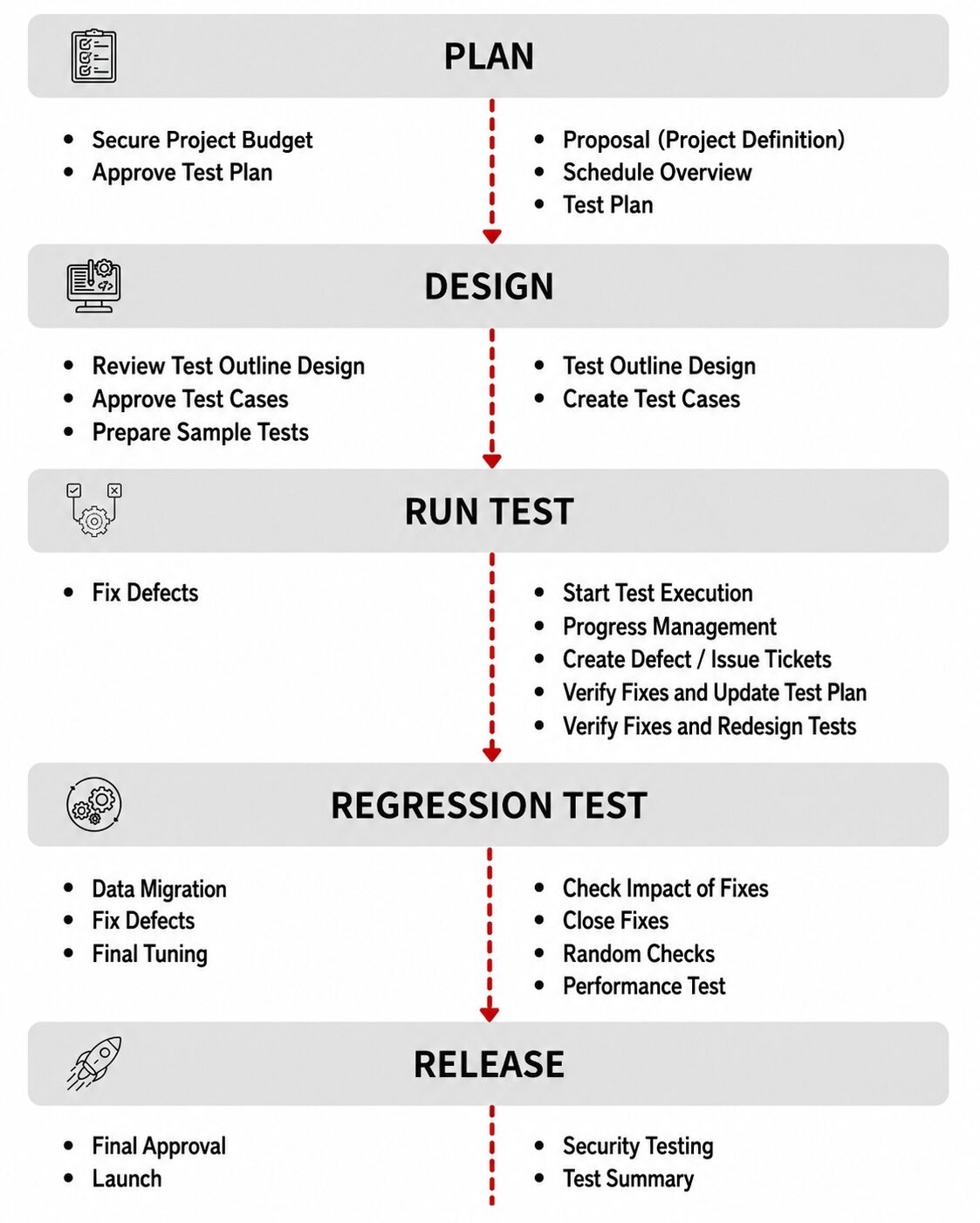
We organize the necessary QCD and plan the test plan and test design approach
QCD stands for Quality, Cost, and Delivery.
It is considered essential to strike a balance among these three factors: Q (Quality), C (Cost), and D (Delivery).
At GENZ, we treat testing as a project.
We organize the necessary QCD requirements, plan the test strategy and outline the test design approach, and establish the necessary measures to proceed to the next phase of test design.
| Background |
We will gather information regarding the history of interactions among stakeholders, their roles, challenges, and issues leading up to this project. We will identify any intractable constraints or long-standing issues and share key considerations for project execution. |
|---|---|
| Goal |
Through this testing effort, we will discuss the quality objectives for the target system, the development team’s quality culture, and cost-related goals. By clearly defining the testing objectives, we will establish a clear focus and aim for steady quality assurance and improvement without overreaching. This includes understanding The user’s perception of quality Assessing the maturity of the testing process within the development team Identifying desired quality characteristics (ISO 9126) and addressing unit testing Integration testing, and system testing within the typical waterfall development phases, etc. |
| TARGET – Test Scope |
We will discuss and clarify the scope. System under test - Target functions / Non-target functions + Peripheral external systems…etc. |
| INPUT – Input Materials |
We will ask for guidance to help structure the tests. Reference materials such as requirement specifications and basic design documents |
| APPROACH – Approach |
We will clarify the design methodology to achieve the test objectives. We will identify critical functions and use cases that cannot be omitted, and document the methods and verification approaches feasible within the constraints. Unit Testing / Integration Testing / System Testing / Performance Testing / Security Testing Normal and abnormal functional scenarios, normal and abnormal functional integration scenarios, normal and abnormal use case flows Tool selection ~ Confirmation of Test Implementation Procedures and Checkpoints |
| PROJECT RISKS |
We clearly state risks related to test execution procedures, risks associated with the target system, and considerations regarding laws and regulations, and urge caution. |
| TESTCASE MANAGEMENT | Confirm the methods for creating and managing test cases, their format, methods for determining pass/fail, management of N/A and N/T cases, and progress management methods. |
| BUG TRACKING – Defect Management |
Specify management methods for bug reporting, bug ranking, priority, severity, and handling workflows. |
| OUTPUT – Deliverables |
Confirm the methods for defect reporting, management procedures, formats, criteria for determining "OK" or "NG," management of "N/A" and "N/T," and progress tracking. |
| ENVIRONMENT – Environment |
Specify the environment of the system under test, client machines, and mobile devices. |
| TIMEFRAME – Schedule |
Specify milestones leading up to the release, review and modification verification schedules, and planned staffing arrangements. |
| STAFFING – Organization |
Specify the administrators, personnel in charge, their roles, and staff training. |
| SUMMARY REPORT CONTENTS – Summary |
Clearly state in advance the test execution process—from the test design approach, test case management, and defect management methods, through to the execution phase—as well as the summary and overall findings to be compiled , and confirm the clues for improvement to be gained through this project. |
| COST – Expenses |
Calculate the budget breakdown for associated costs, including personnel costs, equipment costs, and account fees. |
Related Pages
Please feel free to contact us with any inquiries or requests regarding system testing.