What Is Exploratory Testing?
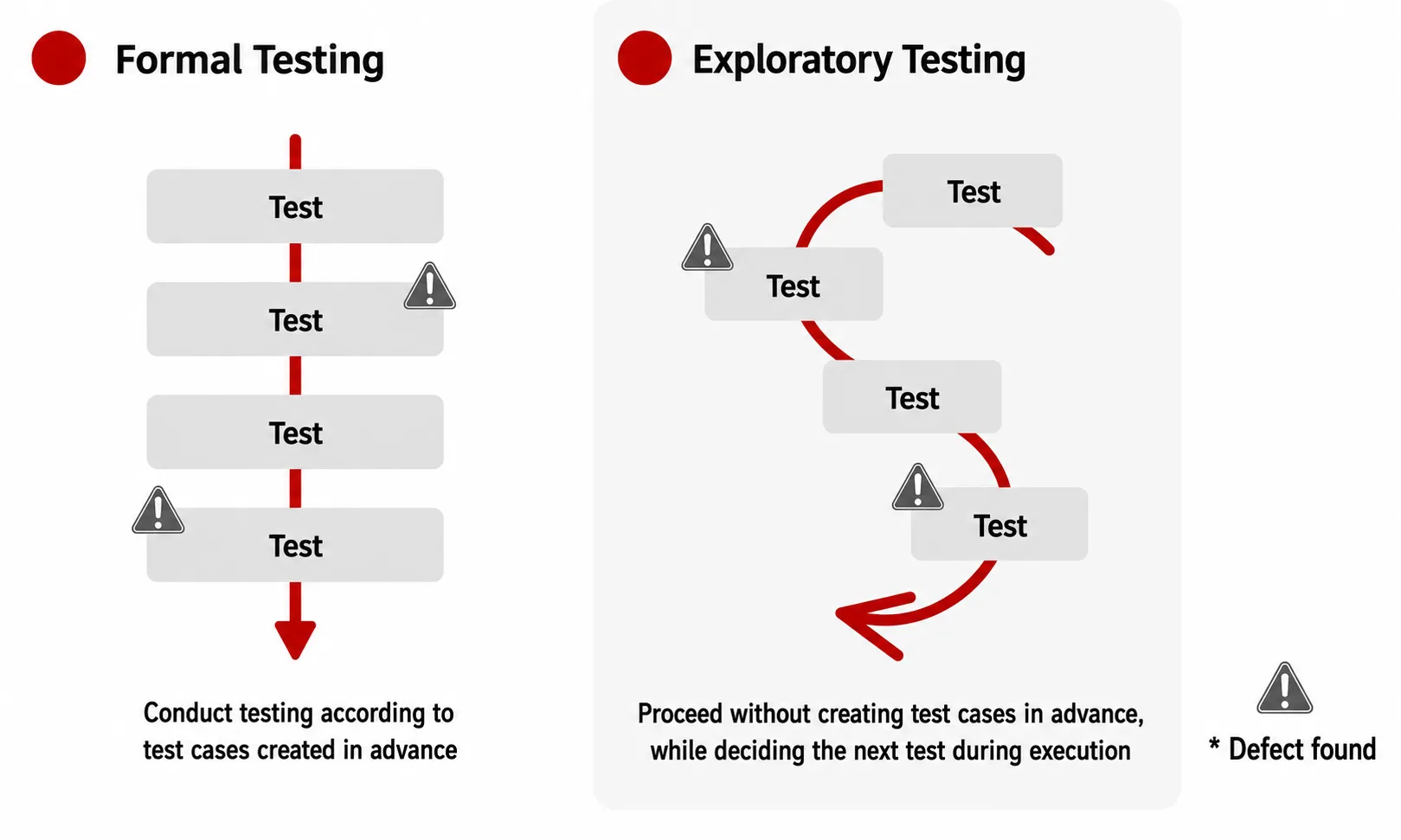
Exploratory testing
is a testing methodology in which the tester simultaneously develops test content and executes tests.
Unlike formal testing, which involves creating test cases (test specifications) in advance, exploratory testing relies on the tester’s experience, past cases, and insights to detect potential defects.
Exploratory testing is more likely to uncover defects that are difficult to detect through tests focused on coverage, such as those performed using predefined test cases.
The Difference Between Exploratory Testing and Ad Hoc Testing
| Exploratory Testing | Ad Hoc Testing | |
|---|---|---|
| Similarities | Test cases are not created in advance | Test cases are not prepared in advance |
| Differences | Tests are initiated after establishing a direction and specific goals | Testers execute tests based on their own ad-hoc decisions and ideas |
| Testing is performed by documenting the execution procedure, data preparation methods, and reproduction methods | Test details, such as procedures and data used, are often not documented | |
| Performed while ensuring reproducibility | It is difficult to identify defects due to a lack of reproducibility |
Exploratory testing is often confused with "ad hoc testing," which is a similar type of testing.
The difference between the two lies in whether the testing objectives and content are defined.
In exploratory testing, even though test cases are not prepared in advance, it is necessary to establish a certain direction and purpose for the testing.
On the other hand, ad hoc testing is more haphazard and spontaneous, akin to random testing, and its main drawback is the reduced ability to reproduce detected defects.
Therefore, exploratory testing should be adopted as the testing methodology for improving quality.
Scope of Exploratory Testing
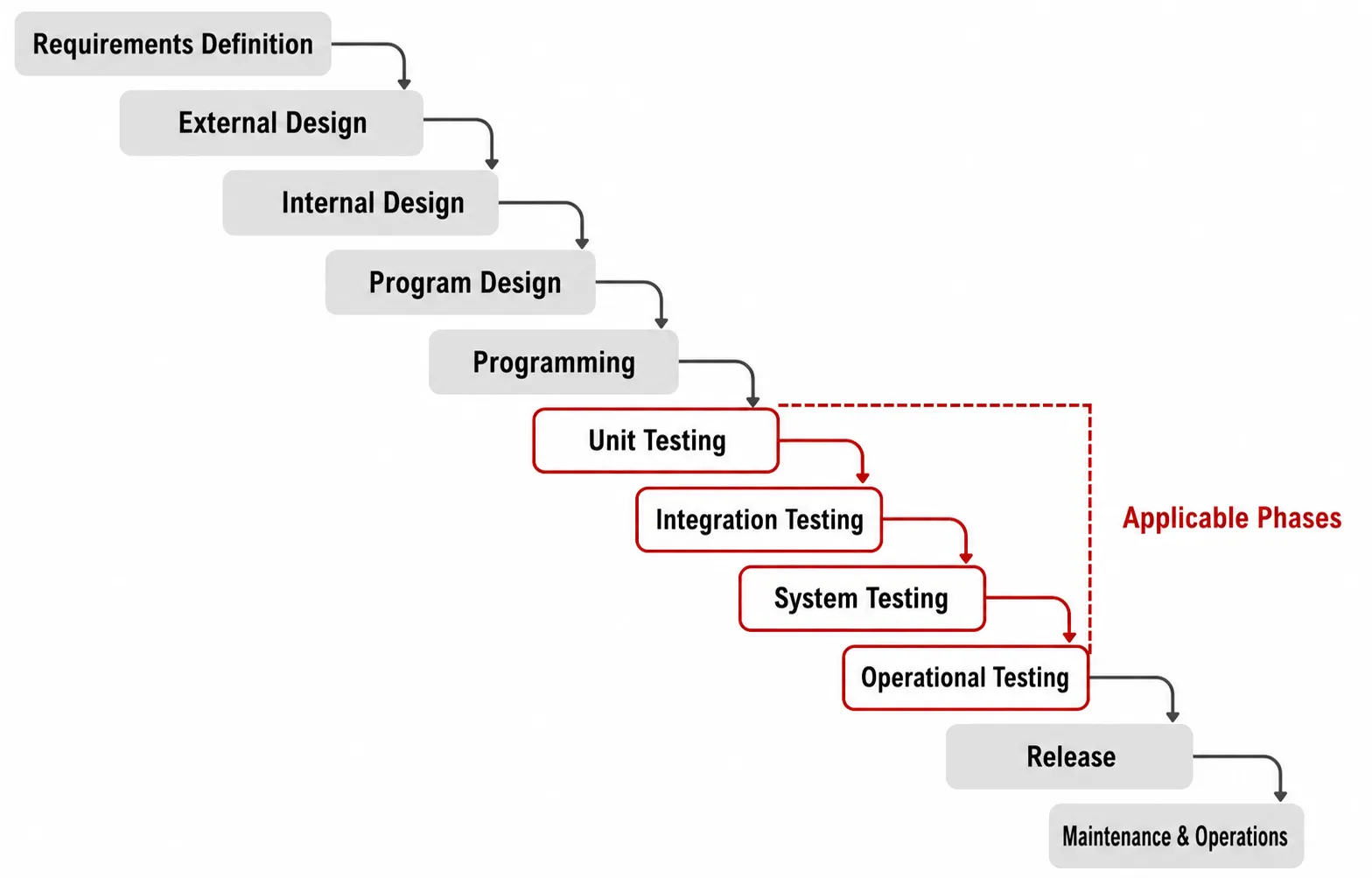
Due to its nature, exploratory testing can be introduced at any phase of the testing process
.
To implement it more effectively, we recommend applying it to broad and diverse testing activities, such as system testing (integration testing) and acceptance testing.
It is also an effective testing method when it is difficult to secure sufficient testing resources, in agile development, or when specifications or design documents are unavailable.
By leveraging the tester’s experience, it enables achieving results with minimal testing effort.
Benefits
- Can be implemented at any stage of the testing process
- Can be implemented even when test inputs (specifications, design documents) are incomplete
- Reduces test preparation effort
- Enables control over the overall man-hours of the testing phase
- Easy to implement in Agile development
Disadvantages
- Highly dependent on individual expertise
- Completeness is not guaranteed
- Increased need for specification-related questions and verification processes with development team members
- Not suitable for testing non-functional requirements
- Cannot perform quantitative quality assessment
About the Test Charter

In exploratory testing, a document called a "test charter" is sometimes created in advance.
A test charter clearly states the direction and objectives of exploratory testing; it serves as a compass to guide testing efforts.
By using this test charter, even testers with limited experience or knowledge can proceed with exploratory testing without getting lost.
At our company, we have compiled this test charter from our own unique perspective and apply it to exploratory testing.