What is performance testing?
What is Performance Testing (Load Testing)?
Performance testing (load testing) is a type of testing that evaluates whether a web system or application can withstand simultaneous access from many users or high loads. We utilize specialized knowledge and tools to provide appropriate test designs.

Purpose of Testing
Performance testing (load testing) aims to replicate anticipated usage scenarios to verify system durability and stability, identify bottlenecks, and proactively prevent issues such as slow page loading, service outages, and resource shortages or over-allocation caused by improper server specifications.
Furthermore, based on the test results, we improve bottlenecks and optimize infrastructure settings to derive cost-effective server specifications, thereby reducing long-term operational costs and enhancing the user experience. Additionally, the test results serve as guidelines for infrastructure scaling and system design improvements, contributing to the achievement of stable operation.
The Importance of Performance Testing
Why is performance testing necessary?
Here, we explain the risks that defects and downtime pose to users and businesses.

Loss of Revenue
When a system goes down, services become unavailable, potentially leading to lost revenue opportunities. For e-commerce sites and subscription services, this can also result in the risk of customer cancellations and significant financial losses.

Increased Operational Costs
Addressing server outages and system failures requires additional costs, such as emergency engineer support and infrastructure upgrades. Allocating excessive resources without proper server sizing leads to unnecessary cost increases, while insufficient resources can cause processing delays and system failures.
As a result, performance degradation or system outages may occur, and the time required for recovery can delay other development tasks and projects, increasing the risk of reduced overall operational efficiency. By performing proper server sizing, it is possible to maintain stable system operation while minimizing unnecessary costs and reducing long-term operational burdens.
Features of GENZ’s Performance Testing Service
We Start by Determining Optimal Performance (Metrics)
Based on performance test results, we support you by working together to set the optimal performance targets required for your system. For example, we define KPIs (Key Performance Indicators) such as concurrent accesses, response time, and resource utilization, and design and execute tests based on these criteria. By visualizing the performance goals you aim to achieve with concrete numbers, we clarify guidelines for future system design and operation.
We work alongside you to identify the best requirements for your service, even if you haven’t fully defined them yourself, and propose the optimal solution
Even if you do not have a clear understanding of the specific performance targets or requirements for your service, we will work with you to define those goals. Based on the current state of your system and operational data, we will investigate what level of load should be tolerated and what response times are appropriate, and propose specific metrics and scenarios. Furthermore, taking into account technical constraints and cost considerations, we will derive feasible and appropriate solutions for you.
We work with you on everything from test execution to server tuning and troubleshooting
Through our services, we analyze the issues identified in performance test results and work with you to devise concrete improvement measures. For example, if server resource utilization is high, we will propose server tuning methods such as changing instances or adjusting scaling settings . We will also work alongside you until the issues are resolved, providing flexible support for any technical questions or operational concerns that arise during the problem-solving process.
We don’t stop at a single round of testing; we also handle additional verification and investigation
The performance testing process is not a one-time event; continuous verification and investigation are essential. Based on the results from an initial test, we can conduct further verification by adding additional load conditions or scenarios . For example, we perform additional testing before the launch of new service features or events expected to drive user growth to confirm the system’s adaptability. Furthermore, even after existing issues have been resolved, we actively conduct investigations to identify any new problems that may arise.
Training on How to Handle Increased Demand After Going Live
If traffic or data volume increases beyond expectations during system operation, the load may rise, causing the system to become unstable . We provide clear, easy-to-understand explanations of specific, practical issues and solutions for handling such spikes in demand, including scalable system design , resource scaling procedures, and cache optimization. This enables you to establish a system capable of responding quickly even if problems arise during operation.
Web System Load Testing Process
Step 1: Consultation
- Understanding Your Needs and Goals
- Specific reasons for conducting the test
- Goals to be achieved through testing, etc.
- System Overview
- Type of system or application to be tested
- System Configuration
- Confirmation of the scope of testing
- Anticipated Load Conditions
- Performance Requirements
- Identify current issues and concerns
- Verification of the Test Environment
- Security Requirements → Are there any security constraints during testing?
- Schedule and Budget
- Review of documents such as system architecture diagrams and design specifications
Step 2: Creating the Test Plan
- Verification of business requirements
- Verification of performance targets
- Determining the division of labor for performance testing
- Identifying Areas for Performance Testing Based on the System Architecture Diagram
- Selecting the test tools to be used
- Selection of the performance testing environment
- Setting the schedule
- Scenario design (time of day, estimated number of users, access patterns)
- Determining personnel
- Defining deliverables
Step 3: Test Execution
- Execution of load testing simulating the production environment
- Monitoring
- Reporting when defects are detected and proposing improvements
Step 4: Analysis and Reporting of Results
- Preparation of detailed test result reports
- Identification of areas for improvement and bottlenecks
- Proposing retests as needed
Testing Tools Used
Introduction to Key Tools
- New Relic (APM products)
- Other Necessary Tools
- JMeter (Client-side)
- CloudWatch (server-side)
Deliverables and Expected Outcomes
Deliverables
- Test Plan
- JMeter Script
- Jmeter Script User Manual (if requested by the client)
- Test Design Document
- Test Log
- Summary Report
- Details of Estimated Bottlenecks
Sample Summary Report
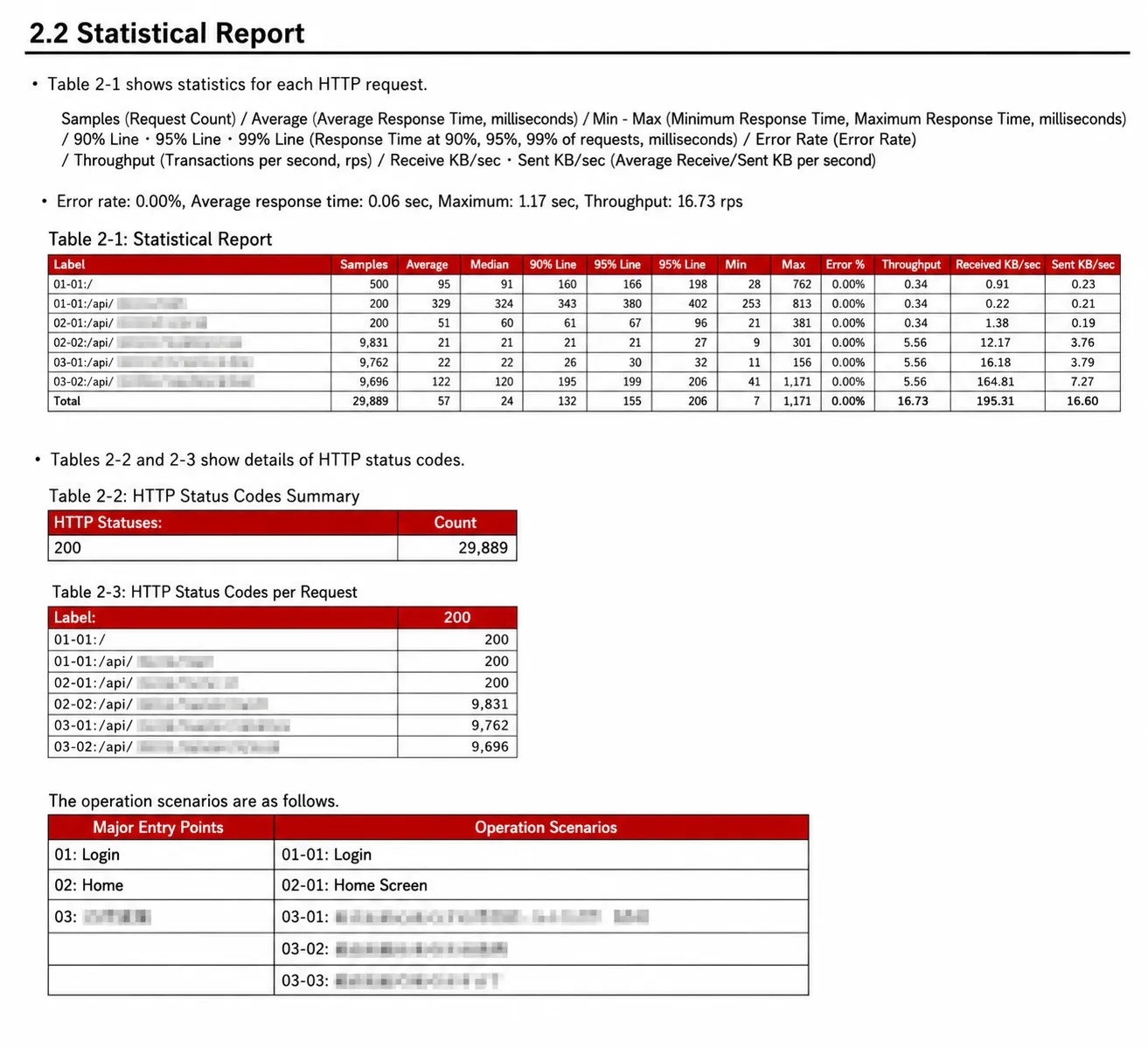
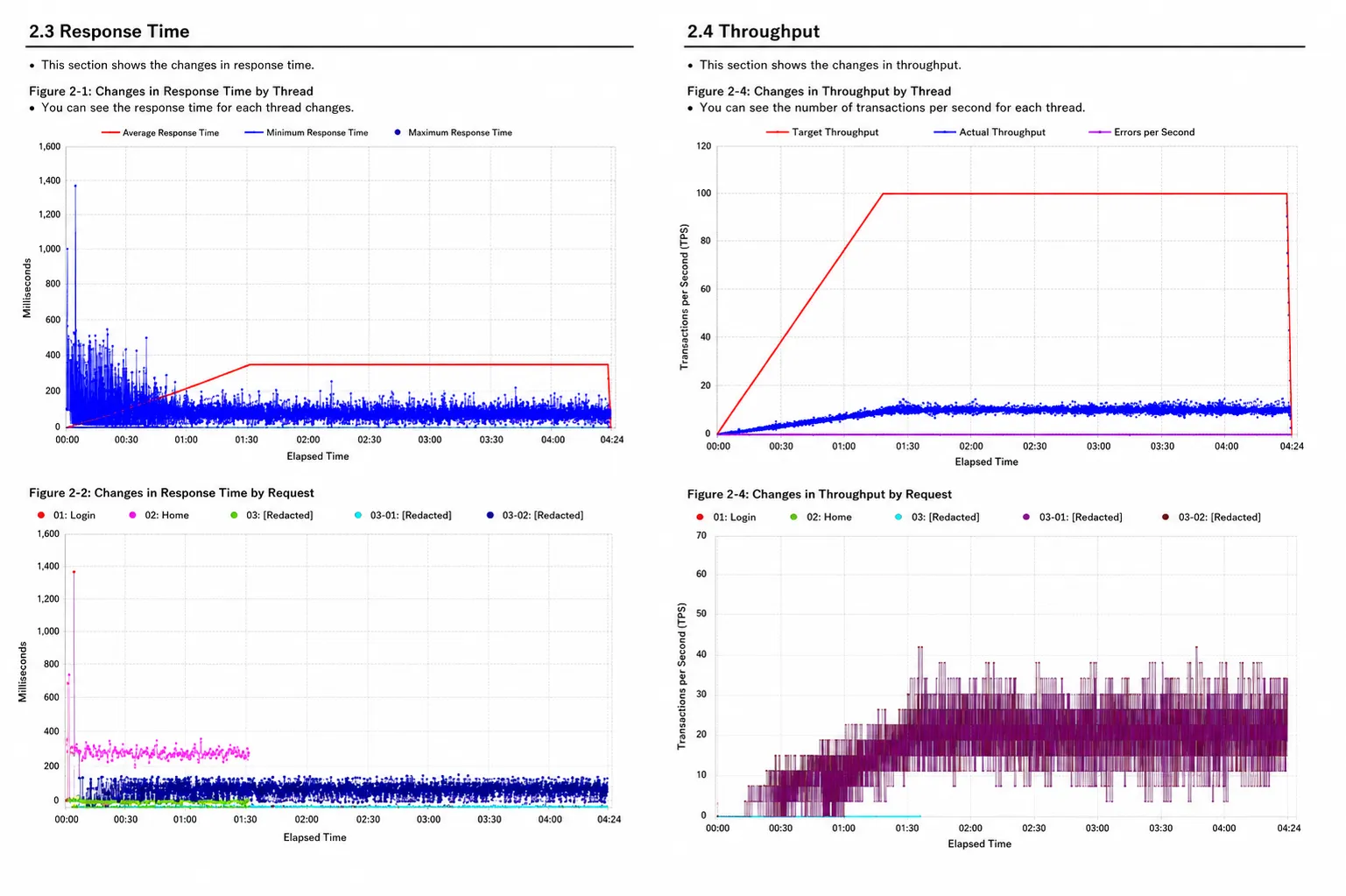
We provide detailed load test results—including "Number of Requests," "Average Response Time," "Maximum and Minimum Values," and "Error Rate"—in a visually intuitive report format using J-Meter graphs and tables.
Summary Report Sample (Excerpt)
Expected Benefits

Improved System Reliability
- Verification of Stability Under High Load – You can verify that the system operates normally even as the number of concurrent accesses and requests increases.
- Failure Prevention – We can identify potential problems caused by load in advance and resolve them before the system goes live.

Performance Improvement
- Identification of Bottlenecks – Identifies areas within the system where processing is delayed or resources are insufficient.
- Improved Response Speed – System response times can be reduced to enhance the user experience (UX).

Improved User Experience (UX)
- Providing a Stress-Free User Environment – User satisfaction increases when page load speeds and data retrieval times meet the expected values defined in the scenario.
- Preventing User Churn – A system free of delays and errors reduces the risk of users switching to competitor services.

Reduction of operational costs
- Reduction of wasted resources – By eliminating unnecessary servers and systems with excessive specifications, efficient resource utilization becomes possible.
- Reduced incident response costs – Preventing issues from occurring after launch reduces costs associated with emergency response.

Verification of scalability
- Design Capable of Supporting Future Growth – Ensures the system can handle increases in user numbers and traffic.
- Appropriate resource allocation – Enables planning for scaling up or out as needed.

Support for Achieving Business Goals
- Minimizing Lost Opportunities – Especially for e-commerce sites and subscription services, system downtime leads to direct revenue loss; ensuring stable operation minimizes lost opportunities.
- Enhancing Brand Value – By providing a highly reliable service, you can earn the trust of customers and business partners.
FAQ
Questions & Answers
As QA experts, GENZ supports high-quality system development. Please feel free to contact us
with any questions or concerns regarding software testing.