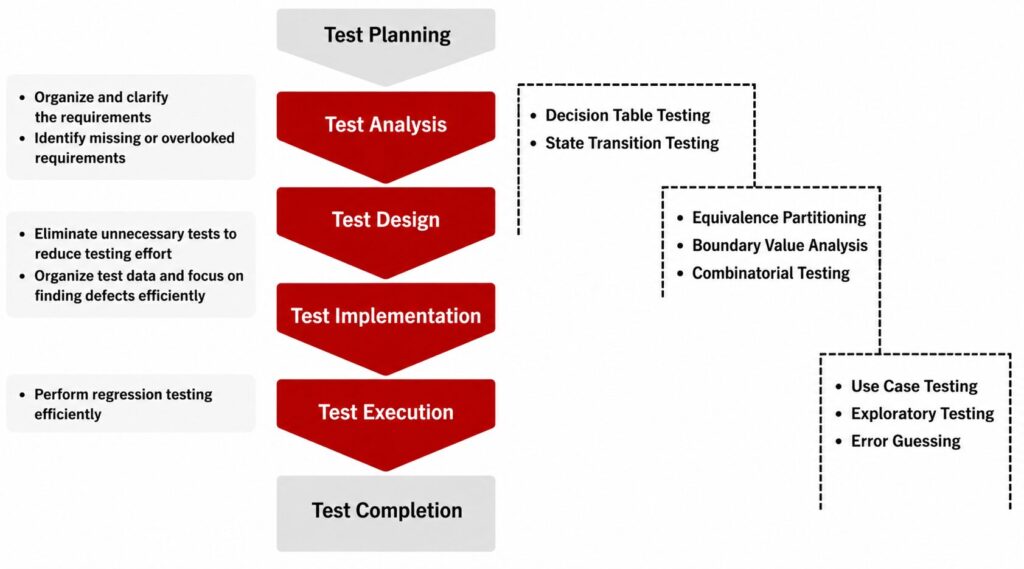
For the target system, we clarify the testing objectives and requirements, organize the test input data, and define the testing process along with expected results and evidence collection methods
as a process that leads to the creation of test cases. We ask about essential functions and use cases that cannot be omitted,
and create a test design specification document using feasible test design approaches and verification methods within the given constraints.
- Unit Testing / Integration Testing / System Testing / Performance Testing / Security Testing
- Normal and abnormal functional scenarios, normal and abnormal functional integration scenarios, normal and abnormal use case flows
- Selection of verification tools and procedures for test implementation
- Verification of Checkpoints
At GENZ, we employ several testing techniques to resolve issues related to the testing process. Furthermore, by organizing testing perspectives according to each testing phase, we strive to improve testing efficiency and prevent omissions.
| No | APPROACH | CONTENTS |
|---|---|---|
| 1 | Unit Testing | Verify that normal, abnormal, and exception handling scenarios function correctly at the smallest unit of software operation. |
| 2 | Single-Function Testing | Verifies functionality at the feature level. This may also be performed at the screen or batch level. |
| 3 | Single-Function Integration Test | A limited test performed on individual functions that are partially interconnected, including their interfaces. Not all functions are tested; instead, those with high novelty or complexity are selected for testing. |
| 4 | CRUD Verification Test | Verifies the interrelationships and processing of Create, Read, Update, and Delete operations for both the user interface and the database. |
| 5 | State Transition Verification | Verify that processing flows according to the screen transition diagram and state transition diagram. At the same time, verify that the system state changes as designed. |
| 6 | Functional Integration Testing | Verify that a specific objective can be achieved by using a set of integrated functions. |
| 7 | Environmental Compatibility Testing | Verifies that the system operates without adverse effects in a mixed environment comprising hardware, middleware, operating systems, security software, and management software. |
| 8 | External Integration Testing | Verify that the system can interface with external systems, primarily through data exchange, ASP integration, replication, direct database access, file exchange via batch files, and data transfer using communication software. |
| 9 | Connectivity Test | Prior to the production rehearsal, verify that the network and hardware are properly connected. |
| 10 | Performance Testing | Verify that expected performance (primarily response time and throughput) is being met at the level of individual APIs and functions. This may be performed during the early stages of system design or after deployment for tuning purposes. |
| 11 | Storage Test | Verifies that the system can handle situations where storage is at capacity. |
| 12 | Volume Testing | Send a large volume of data (including both large individual data sets and many small ones) and verify that processing completes successfully within the specified time. |
| 13 | Load Testing | Conduct tests to reproduce load conditions such as ramp-up, peak hold, and spikes, and perform a preliminary investigation of bottleneck areas. |
| 14 | Current vs. New System Comparison Test | Compare results by using the same data on both the current and new systems. Plan and execute the test using one of the following data types: cleansed test data, production mask data, migration data, or production data. |
| 15 | Migration Scenario Testing | In preparation for production launch, develop and execute scenarios related to the system migration. These include rehearsals. |
| 16 | Operational Testing | We will conduct operational rehearsals using business logic or information equivalent to the manuals used in production as input to confirm that there are no issues. |
| 17 | Business Cycle Testing | Perform closing procedures for daily, monthly, year-end, fiscal year-end, and leap year cycles in a simulated environment to verify that the cycles function correctly. This includes verifying batch error handling and checking for any missed processing. |
| 18 | Current and Historical Data Reconciliation Test | Process historical data to be migrated as input to confirm that there are no issues. If discrepancies are found, investigate the cause and use the findings as input for reviewing the environment and system. |
| 19 | Fault Tolerance and Recovery Testing | Verify the system’s tolerance for failures such as errors, communication failures, and disk space exhaustion, as well as the estimated recovery time. |
| 20 | Ad Hoc Testing | Testers and non-involved personnel perform tests based on specific criteria to verify that there are no critical issues. |
| 21 | Infrastructure Testing | Verify that migration, replication, and failure monitoring tools operate without issues in a production-like environment. This includes error log tuning. |
| 22 | User Testing | Conduct tests with personnel not involved in the development process, focusing on usability and other key aspects. |
| 23 | Comparison of Current and New Systems | The same data is fed into both the current and new systems to verify that there are no discrepancies in the results and, if discrepancies exist, to identify the reasons for them. |
| 24 | Security Testing | Use vulnerability assessment tools and manual inspections to check for security holes in the application and network, and evaluate the presence and severity of risks after release. |
Test Criteria and Test Case Creation
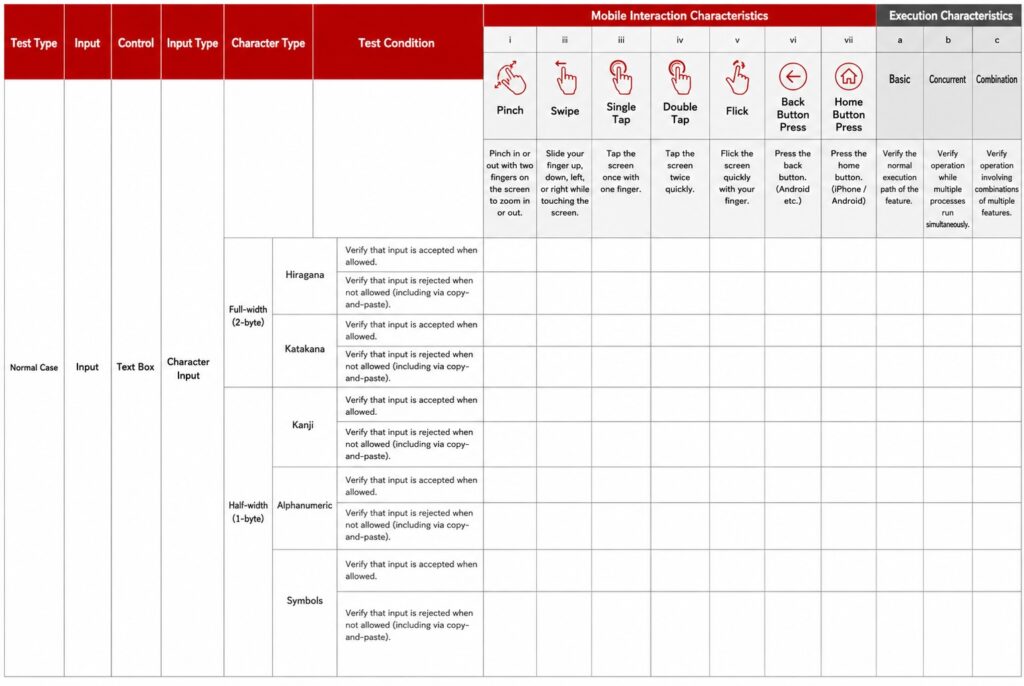
Test criteria vary depending on the test phase being conducted. At GENZ, we organize test criteria based on the test phase and the scope of testing, and use them to create test cases.
Test cases must be written clearly so that anyone can achieve the same results. If test cases are unclear, testers will frequently need to confirm details against the specifications, which ultimately leads to an increase in testing time. At GENZ, we leverage our extensive testing experience to implement creative solutions that minimize testing time.
Examples of Test Criteria and Test Cases